

Why is a three lobe rotary blower with V-belt drive preferred for abrasive calcium carbonate handling
2026-04-29
When handling abrasive materials like calcium carbonate, equipment durability and operational reliability become critical. The Yinchi three lobe rotary blower with V-belt drive has emerged as a preferred solution across mineral processing and industrial conveying applications. Unlike standard designs, this blower configuration balances particle resistance, energy efficiency, and long service life—especially within a Calcium Carbonate Conveying Three Lobe V-Belt Roots Rotary Blower system.
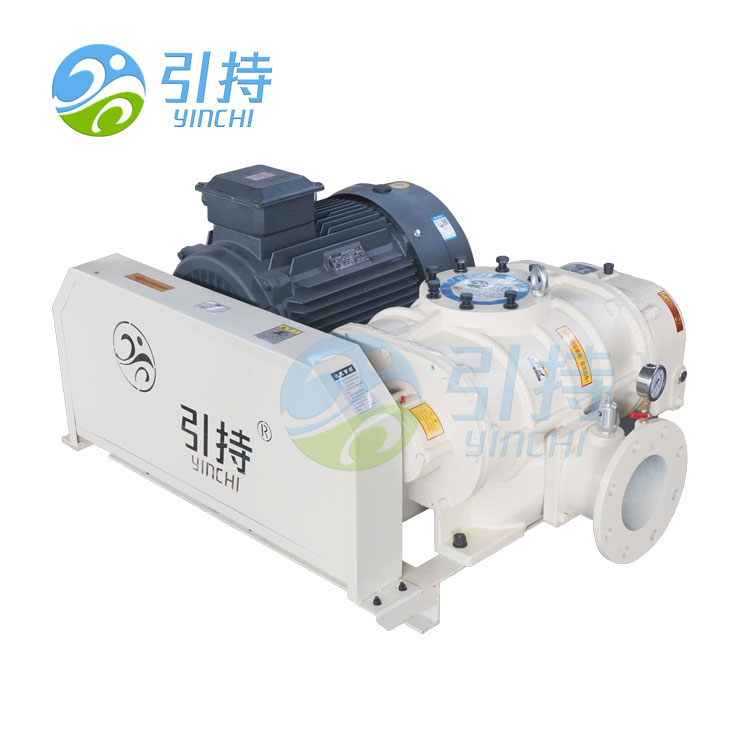
Key technical advantages for abrasive calcium carbonate handling
The table below outlines why the three lobe V-belt design outperforms conventional blowers in calcium carbonate applications.
| Feature | Benefit for abrasive calcium carbonate |
|---|---|
| Three lobe rotor design | Reduces pulsation and backflow, minimizing particle impact on internal surfaces |
| V-belt drive system | Absorbs shock loads from density fluctuations, protecting the gearbox and bearings |
| Hardened rotor coatings | Resists erosion from fine, sharp calcium carbonate crystals |
| Lower operating temperature | Prevents material caking and bearing degradation in prolonged conveying cycles |
Why abrasion resistance matters in calcium carbonate conveying
Calcium carbonate particles, especially in ground or precipitated forms, act as micro-abrasives. Over time, they erode rotors, housing walls, and seals. The Yinchi three lobe design creates larger air pockets and smoother discharge, reducing direct particle-to-metal friction. Additionally, the V-belt drive allows controlled slip under heavy loads, which prevents sudden torque spikes that accelerate wear.
Performance comparison: Three lobe V-belt vs. Two lobe direct drive
| Parameter | Three lobe V-belt blower | Two lobe direct drive |
|---|---|---|
| Pulsation amplitude | Low | High |
| Abrasion resistance | High (softer torque curve) | Moderate |
| Maintenance frequency | Lower due to belt dampening | Higher |
| Energy efficiency at variable loads | Excellent | Good only at fixed loads |
The V-belt arrangement also simplifies motor replacement and speed adjustments without specialized tools—a practical benefit for plants handling different grades of calcium carbonate.
Calcium Carbonate Conveying Three Lobe V-Belt Roots Rotary Blower FAQ
Question 1: How does the three lobe design reduce wear when conveying abrasive calcium carbonate compared to a two lobe blower?
Answer: The three lobe rotor creates three separate compression cycles per revolution instead of two. This reduces peak pressure pulsations by approximately 30-40%. Lower pressure spikes mean air velocity remains more constant, so calcium carbonate particles are less likely to impact housing walls at high speed. Additionally, the overlapping lobe geometry minimizes backflow, which prevents particles from being repeatedly recirculated and striking the rotor tips. Yinchi further hardens the rotor surfaces using anti-abrasive coatings standard on their Calcium Carbonate Conveying Three Lobe V-Belt Roots Rotary Blower models.
Question 2: Why is a V-belt drive specifically better than direct coupling for abrasive calcium carbonate handling?
Answer: A V-belt drive acts as a mechanical fuse and shock absorber. When dense slugs of calcium carbonate enter the conveying line, system pressure spikes momentarily. The V-belt slips slightly under sudden torque demand, preventing that shock from transferring to the blower’s timing gears and bearings. Direct drives transmit 100% of the shock, leading to premature gear pitting and bearing fatigue. Furthermore, V-belts dampen high-frequency vibration caused by abrasive particle impact on rotors. Yinchi equips its blowers with industrial-grade V-belts that maintain tension stability even in dusty calcium carbonate environments.
Question 3: What maintenance signs indicate that a three lobe V-belt blower needs attention in calcium carbonate service?
Answer: Three critical signs are belt glazing (shiny belt sides), increased discharge temperature beyond 110°C, and a gradual drop in conveying pressure at constant motor current. Belt glazing indicates slippage from calcium carbonate dust contamination, requiring belt replacement and dust sealing inspection. Rising temperature suggests rotor coating wear or internal clearance increase due to abrasion. Pressure drop without motor load change often means rotor timing has shifted slightly—a belt tension adjustment usually resolves this. Yinchi recommends inspecting belts every 500 operating hours and replacing rotor seals every 2000 hours for heavy calcium carbonate duty.
Best practices for extending blower life with calcium carbonate
-
Install a heavy-duty inlet filter with cyclone pre-separator to remove large agglomerates
-
Maintain conveying velocity between 15-25 m/s to avoid saltation or excessive abrasion
-
Use a pressure relief valve set 10% above maximum operating pressure
Contact us
Optimize your calcium carbonate conveying system with Yinchi durable three lobe V-belt blowers. Our engineering team provides custom sizing, abrasion-resistant coatings, and on-site support. Contact us today to request a performance analysis or quote for your specific material handling line.