

What Makes a Pocket Thermal Printer So Portable?
2026-09-23
A delivery driver pulls a Thermal Printer out of a jacket pocket, prints a receipt on the doorstep, and hands it to the customer. The whole transaction takes 15 seconds. The printer never touched a bag. That is the standard for true portability. Many printers marketed as portable are actually transportable: they fit in a backpack, but not in a pocket. The difference comes down to four factors that determine whether a device is genuinely pocket-sized: weight, dimensions, battery life, and paper loading method. This guide is written for field workers and operations managers who need a Thermal Printer that can be carried all day without becoming a burden.
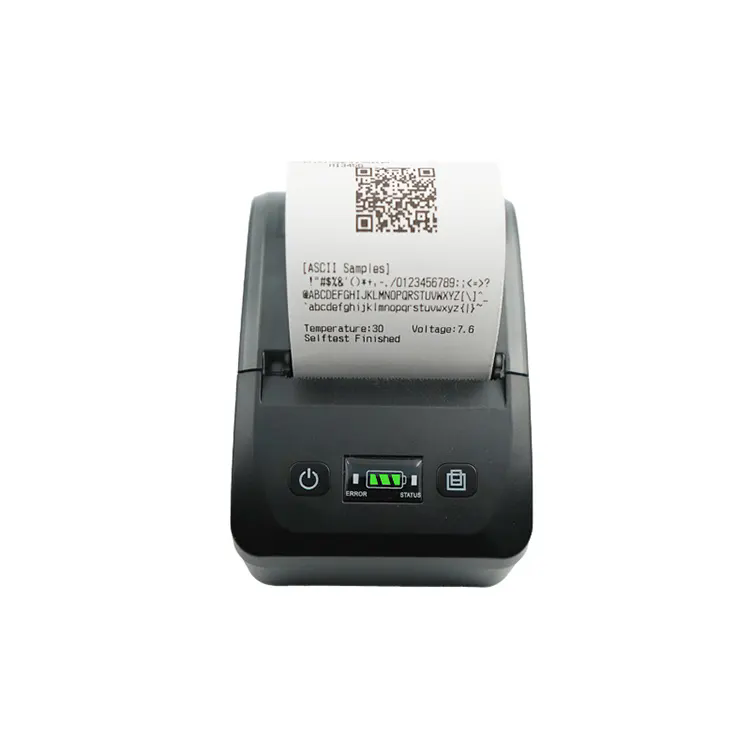
1. What Weight and Dimensions Define a True Pocket Thermal Printer?
The definition of pocket-sized is not subjective. For a device to be carried comfortably in a jacket pocket or a belt holster for an entire shift, it must meet three criteria. First, the weight must be under 300 grams. Above 300 grams, the device pulls on the pocket and becomes noticeable after an hour. Second, the thickness must be under 40 mm. A thicker device creates a bulge that is uncomfortable when sitting or bending. Third, the footprint must be smaller than a standard smartphone. The table below shows the weight and dimension thresholds for different carry methods.
| Carry method | Maximum weight | Maximum thickness | Maximum footprint |
| Shirt pocket | 180 grams | 25 mm | 100 x 70 mm |
| Jacket pocket | 300 grams | 40 mm | 120 x 80 mm |
| Belt holster | 450 grams | 50 mm | 140 x 90 mm |
| Shoulder strap | 700 grams | 60 mm | 180 x 120 mm |
In our factory, we design pocket Thermal Printer units to meet the jacket pocket specification: under 300 grams, under 40 mm thick, and a footprint smaller than a smartphone. The housing is made from impact-resistant polycarbonate, which is lighter than aluminum and does not dent. The internal components are arranged to minimize the thickness, with the battery and the print mechanism stacked rather than placed side by side.
2. How Does Battery Capacity Affect All-Day Portability?
A light printer with a short battery life is not portable. It is a paperweight that needs a charging cable every two hours. The battery capacity determines how many receipts can be printed per charge. For a delivery driver who prints 200 receipts per shift, the printer must have enough capacity to cover the entire shift without recharging. The capacity is measured in milliampere-hours (mAh). A 1,500 mAh battery can print approximately 300 receipts. A 2,500 mAh battery can print approximately 500 receipts. The table below shows the relationship between battery capacity and print volume.
| Battery capacity | Typical print volume per charge | Weight of battery | Recommended for |
| 1,000 mAh | 150 – 200 receipts | 25 grams | Light duty (50 receipts/day) |
| 1,500 mAh | 250 – 350 receipts | 35 grams | Medium duty (100 receipts/day) |
| 2,000 mAh | 400 – 500 receipts | 45 grams | Heavy duty (200 receipts/day) |
| 2,500 mAh | 500 – 650 receipts | 55 grams | Very heavy duty (300+ receipts/day) |
Xiamen Peite Electronic Technology Co., Ltd. manufactures pocket Thermal Printer units with 1,500 mAh and 2,000 mAh battery options. Our factory uses lithium-polymer cells that are lightweight and have a low self-discharge rate. The battery is removable, so the user can carry a spare and swap it without tools. The charging time is 2 hours for a full charge via USB-C.
3. Why Does Paper Loading Method Matter for Field Use?
The paper loading method is the most overlooked factor in portability. A printer that requires the user to thread the paper through a complex path will be slow and frustrating in the field. The best design is a drop-in loading system. The user opens the cover, drops the paper roll into the compartment, and closes the cover. The paper is automatically positioned. No threading, no alignment. The table below compares different paper loading methods.
| Loading method | Time to load | Risk of misfeed | Suitability for field use |
| Drop-in (clam shell) | 5 – 10 seconds | Low | Excellent |
| Slide-in with guide | 15 – 25 seconds | Moderate | Good |
| Thread-through | 30 – 60 seconds | High | Poor |
| Proprietary cassette | 10 – 15 seconds | Very low | Good (but cassette cost) |
Our factory uses a clam shell drop-in loading design for all of our pocket Thermal Printer models. The cover is hinged and latches securely. The paper roll is held in place by a spring-loaded spindle that accommodates rolls from 30 mm to 50 mm in diameter. This design allows the user to change paper in under 10 seconds, even with gloves on.
4. How Do Connectivity and Durability Affect Real-World Portability?
A portable printer must connect to the user's device without cables. Bluetooth is the standard for pocket Thermal Printer units. The connection should be stable and should not drop when the user moves around. The printer should also support USB-C for charging and for wired connection as a backup. Durability is the other factor. The printer should survive a drop from waist height onto concrete. It should be resistant to dust and light rain. In our factory, we test our pocket printers with a 1.2-meter drop test and an IP54 rating for dust and water resistance. We also test the print head life to 50 km of paper, which is equivalent to over 100,000 receipts. These specifications ensure that the printer remains functional in real field conditions.
Frequently Asked Questions About Pocket Thermal Printer Portability
Summary for Field Workers and Operations Managers
A pocket Thermal Printer is truly portable when it meets three criteria: it weighs under 300 grams, it fits in a jacket pocket or belt holster, and it has enough battery capacity to last a full shift. The paper loading method should be drop-in, so the user can change rolls quickly without frustration. The printer should be durable enough to survive drops and dust. When these factors are combined, the printer becomes a tool that the user carries without thinking about it, which is the definition of true portability. Xiamen Peite Electronic Technology Co., Ltd. has been manufacturing pocket Thermal Printer units for over 10 years and supplies to field service companies worldwide.
Xiamen Peite Electronic Technology Co., Ltd. manufactures pocket Thermal Printer units with 1,500 mAh and 2,000 mAh batteries, drop-in paper loading, and IP54-rated housings. We provide full technical specifications and field test reports.