

What maintenance does a High Frequency Online UPS require
2026-10-15
HAGOE is a leading power protection solutions provider with 19 years of field operation experience in data center, medical facility and industrial power supply scenarios, and its High Frequency Online UPS series has been widely adopted by global small and medium-sized enterprises to deliver zero-switchover-time stable power output for critical loads. Unlike traditional low-frequency UPS units that rely on heavy transformers, high frequency models feature compact size, high energy efficiency and lower heat generation, but their long-term reliable operation still depends on a standardized, periodic maintenance system that matches their technical characteristics. This article breaks down verified maintenance guidelines, field operation data and common troubleshooting tips to help facility managers maximize the service life of their power protection equipment.
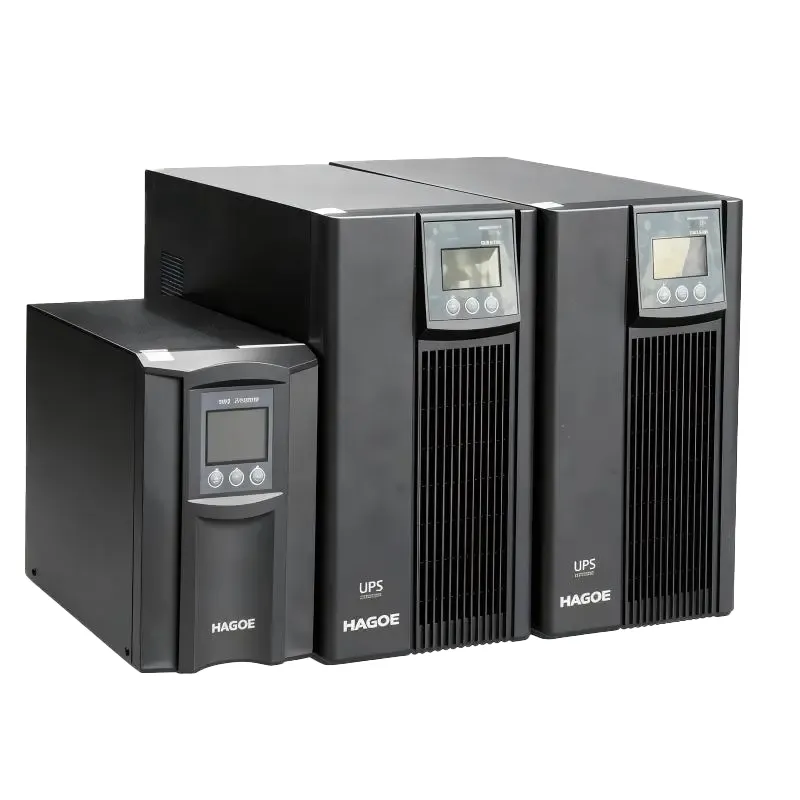
Core Standard Maintenance Schedule
The maintenance work of a High Frequency Online UPS can be divided into three levels according to operation frequency and technical difficulty, forming a full-cycle protection system that covers all key components:
- Monthly visual inspection: Check the unit’s operating status indicator, cooling fan operation sound, and surrounding ventilation condition, remove dust accumulated on the air inlet filter screen to avoid heat dissipation blockage.
- Quarterly electrical performance test: Record the input voltage fluctuation range, output voltage stability and battery float charging voltage data, compare them with the baseline values after the last maintenance to spot abnormal trends in advance.
- Annual deep functional calibration: Conduct a full load simulated power-off test, verify the battery pack discharge performance, calibrate the output voltage and frequency accuracy, and tighten all main power connection terminals to eliminate hidden loose contact risks.
Below is the reference maintenance cost and expected effect table for different capacity models:
| UPS Capacity | Monthly Inspection Time | Annual Deep Maintenance Time | Expected Extended Service Life |
|---|---|---|---|
| 1-10kVA | 15 minutes | 1.5 hours | 3-5 extra years |
| 10-30kVA | 25 minutes | 3 hours | 2-4 extra years |
| 30-100kVA | 40 minutes | 6 hours | 2-3 extra years |
High Frequency Online UPS FAQ
Q: What will happen if the air filter of the High Frequency Online UPS is not cleaned for more than 6 months?
A: The accumulated dust will block the air circulation channel of the unit, causing the internal IGBT power module to overheat, triggering the over-temperature protection alarm, and in severe cases, it will force the UPS to switch to bypass mode directly, losing the online power protection function for the critical loads.
Q: How often should the valve-regulated lead-acid batteries matched with the High Frequency Online UPS be replaced under normal maintenance conditions?
A: With proper temperature control kept between 20-25℃, regular float voltage inspection and 3-month shallow discharge activation, the service life of the supporting batteries can reach 5-8 years, which is 2-3 years longer than the average service life under unmaintained operation conditions.
Q: Can non-professional on-site maintenance personnel open the internal power cavity of the High Frequency Online UPS for inspection without professional training?
A: No. Even when the unit is in standby state, there is still dangerous high DC voltage stored in the internal DC bus capacitor, which may cause electric shock injury. All internal high-voltage component maintenance work must be completed by certified technical engineers who have received professional operation training.
As a High Frequency Online UPS brand that focuses on long-term operational reliability, HAGOE provides every user with a free 1-year standard maintenance service package and a dedicated 7*24 hour technical support hotline. Contact us today to get a customized full-cycle maintenance plan tailored to your unit capacity, operating environment and load characteristics, to ensure your critical power protection system runs stably without unexpected downtime risks.