

What Is the Typical COP of a Modern Water Cooled Screw Chiller Under Full Load Conditions
2026-07-03
When evaluating industrial cooling solutions, few metrics matter more than the Coefficient of Performance (COP). For facility managers, HVAC engineers, and plant operators, the COP of a Water Cooled Screw Chiller directly translates to operating costs, energy compliance, and environmental impact. But what number should you actually expect from a modern unit—and what factors can push that figure higher or lower?
At Ecoair, we design and supply Water Cooled Screw Chiller systems that consistently achieve full‑load COP values between 5.0 and 6.5 (at standard AHRI conditions: 44°F leaving chilled water, 85°F entering condenser water). However, premium high‑efficiency models with oversized evaporators and economisers can reach COP 7.0+ under ideal load profiles. This blog breaks down the real‑world numbers, the engineering variables behind them, and how to verify performance on your own floor.
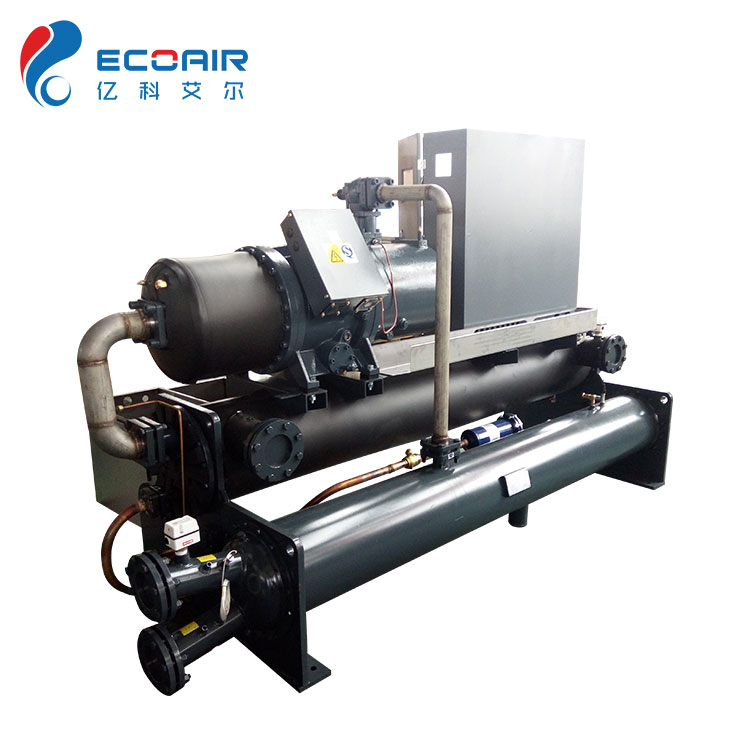
Understanding Full‑Load COP: The Baseline
Full‑load COP is defined as the ratio of cooling capacity (kW) to total electrical power input (kW) at design conditions. It is the single most cited figure in tender documents, yet it is often misunderstood.
| Condition Parameter | Standard AHRI Rating | Typical Variation Range |
|---|---|---|
| Chilled water outlet temperature | 44°F (6.7°C) | 40–55°F |
| Condenser water inlet temperature | 85°F (29.4°C) | 75–95°F |
| Evaporator fouling factor | 0.0001 h·ft²·°F/Btu | 0.00005–0.0003 |
| Condenser fouling factor | 0.00025 h·ft²·°F/Btu | 0.0001–0.0005 |
| Refrigerant type | R‑134a / R‑513A | Low‑GWP alternatives |
Key insight: A Water Cooled Screw Chiller rated at COP 6.0 under AHRI conditions may deliver only COP 4.8 if your condenser water rises to 95°F—a 20% penalty. Ecoair provides site‑specific performance curves with every quotation, so you never rely on brochure numbers alone.
Why Modern Screw Compressors Achieve Higher COP
Today’s Water Cooled Screw Chiller designs benefit from three major advancements:
-
Twin‑rotor profile optimisation – Asymmetric male/female rotors with improved sealing lines reduce internal leakage (blow‑through), increasing volumetric efficiency by 8–12%.
-
Variable Vi (internal volume ratio) – Electronic slide valves adjust the built‑in compression ratio to match actual lift conditions, avoiding over‑ or under‑compression losses.
-
Flooded evaporators with enhanced tubes – High‑density finned tubes and optimized refrigerant distributors improve heat transfer, allowing closer approach temperatures (as low as 2–3°F).
Ecoair integrates all three technologies in our EC‑S series, delivering verified full‑load COP of 6.2–6.8 across 200–1,500 TR range, with independent third‑party witness testing available.
Real‑World COP: What Affects It Most?
Even the best Water Cooled Screw Chiller will underperform if system design ignores these variables:
-
Condenser water flow rate – Below 2.4 gpm/TR increases lift; above 3.0 gpm/TR wastes pumping energy.
-
Part‑load vs. full‑load – Most chillers run 70–80% load; IPLV (Integrated Part‑Load Value) is often more important than full‑load COP for annual energy cost.
-
Refrigerant charge – Undercharge reduces evaporator effectiveness; overcharge floods the condenser, raising discharge pressure.
-
Cooling tower setpoint – Every 1°F reduction in condenser water inlet improves COP by approximately 1.5–2.0%.
FAQ – Common Questions About Water Cooled Screw Chiller Performance
Q1: How does the COP of a Water Cooled Screw Chiller compare to a centrifugal chiller at full load?
A: At full load, a high‑end Water Cooled Screw Chiller (COP 6.0–6.5) is slightly below a centrifugal (COP 6.5–7.2) in the 500+ TR range. However, screws excel at part‑load and under variable lift conditions, where centrifugal units risk surge. For mid‑size applications (150–600 TR), the screw often delivers better annual energy performance because real operating hours occur at 60–80% load. Ecoair offers both technologies and conducts a full life‑cycle analysis to recommend the optimal match for your load profile.
Q2: Can I improve an existing Water Cooled Screw Chiller COP without replacing the compressor?
A: Absolutely. Four proven retrofits deliver 8–15% COP gains: (a) installing an electronic expansion valve with superheat control (±0.5°F accuracy), (b) adding a liquid‑to‑suction heat exchanger for sub‑cooling, (c) upgrading the condenser tube bundle to high‑efficiency finned tubes, and (d) implementing condenser water temperature reset based on ambient wet‑bulb. Ecoair provides retrofit audits with guaranteed performance uplift—we measure baseline COP on‑site before and after intervention.
Q3: Why does my Water Cooled Screw Chiller show lower COP in summer than the factory test report?
A: Factory tests use controlled cooling tower water at 85°F entering condenser. In summer, many sites see 92–95°F due to high wet‑bulb temperatures, which raises condensing pressure by 15–25 psi. Each 1 psi increase in discharge pressure reduces COP by roughly 0.3–0.5%. Additionally, fouling from untreated tower water can add a 3–5°F approach penalty. Ecoair recommends monthly condenser tube cleaning and a tower bypass for cold‑weather months. We also supply real‑time performance monitoring dashboards that isolate weather‑related losses from mechanical degradation.
Best Practices to Verify Your COP
| Action | Frequency | Target Tolerance |
|---|---|---|
| Calibrate flow meters (evaporator & condenser) | Quarterly | ±2% of reading |
| Check refrigerant purity (non‑condensables) | Semi‑annually | <1.5% by volume |
| Measure approach temperatures (evap & cond) | Monthly | Within 2°F of new‑unit baseline |
| Log kW/TR with ambient conditions | Continuous | Compare to Ecoair performance curves |
| Inspect oil return system operation | Weekly | Oil level stable ±5% |
The Bottom Line for Your Facility
A modern Water Cooled Screw Chiller from a reputable manufacturer like Ecoair will deliver full‑load COP between 5.8 and 6.8 under standard conditions. But the real value lies in predictable performance across all seasons, low degradation over 15+ years, and transparent data to back every claim. We do not publish optimistic numbers—we publish guaranteed minimum COP at your specific design conditions, backed by on‑site witness testing.
Ready to Optimise Your Cooling Plant?
Every facility has unique load patterns, water quality, and space constraints. Ecoair engineers do not just supply a Water Cooled Screw Chiller—we model your entire system, including pumps, towers, and variable‑speed drives, to maximise system COP, not just compressor COP.
Contact us today for a no‑obligation energy audit and a tailored performance guarantee. Our team provides full technical submittals, 3D BIM models, and remote monitoring integration. Let’s make your next chiller investment your last for the next two decades. Reach out via our website or call your regional Ecoair representative—we are ready to quote, simulate, and deliver.