

What Are the Typical Applications of a 150KVA Dry Type Isolation Transformer
2026-10-30
A 150KVA Dry Type Isolation Transformer is a three-phase, air-cooled power conditioning unit that electrically separates primary and secondary circuits while stepping voltage up or down at 150 kilovolt-amperes capacity. Because it contains no oil, it eliminates fire and leakage risks, making it suitable for indoor installation in commercial buildings, hospitals, and production floors. GUANGBIAN manufactures 150KVA Dry Type Isolation Transformer units with Class H insulation, copper windings, and low audible noise, serving projects across more than 40 countries. This article outlines where these transformers are deployed in practice and what engineers should verify before specification.
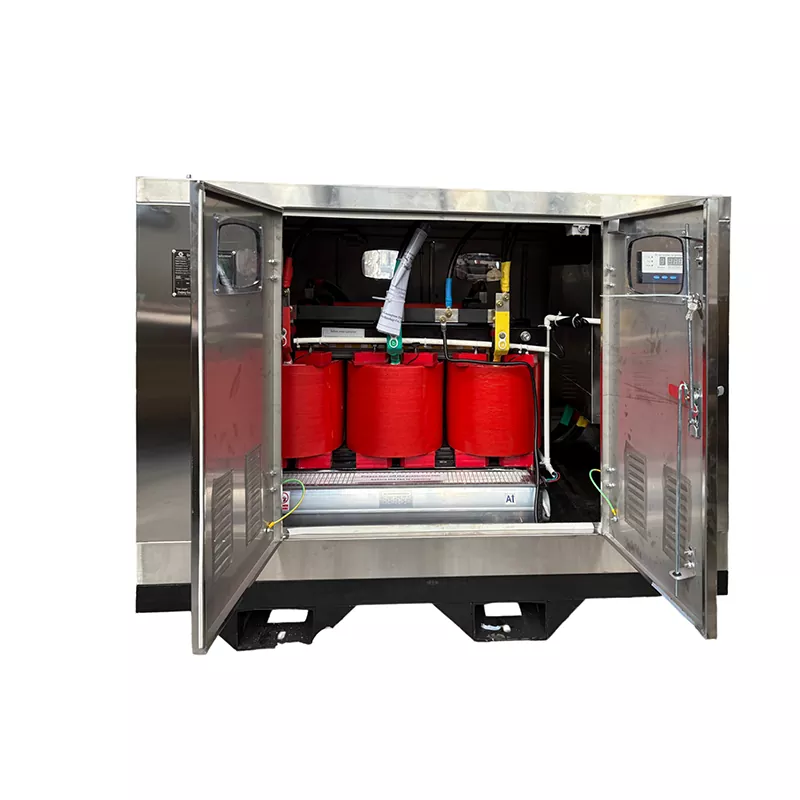
Core Application Areas
The table below summarizes the most common deployment scenarios and the technical reason each one favors a dry type design.
| Application | Typical Load | Why a 150KVA Dry Type Isolation Transformer Fits |
|---|---|---|
| Commercial buildings | HVAC, elevators, lighting panels | Zero oil fire risk; installs near occupied spaces |
| Hospitals and clinics | Imaging equipment, operating rooms | Suppresses common-mode noise; supports isolated grounding |
| Data centers | UPS bypass, server PDUs | High short-circuit withstand; easy thermal monitoring |
| Manufacturing plants | CNC machines, welding controls | Handles harmonic-rich loads; voltage matching 480V/208V |
| Laboratories | Sensitive analyzers, test benches | Attenuates transients and ground loops |
| Renewable energy | Inverter auxiliary circuits | Compact footprint; indoor-rated enclosure |
Detailed Use Cases
Commercial and institutional facilities. A 150KVA Dry Type Isolation Transformer commonly steps 480V distribution down to 208Y/120V for tenant panels. Dry construction allows placement in electrical closets without sprinkler upgrades.
Healthcare environments. Isolation limits leakage current and reduces electrical noise feeding diagnostic imaging systems. GUANGBIAN offers shielded windings that lower common-mode interference.
Industrial automation. Motor drives and welders inject harmonics; a K-rated dry type unit absorbs these without derating. Copper windings and Class H insulation tolerate elevated temperatures.
Data and telecom rooms. These transformers support UPS distribution and create a separately derived system for neutral bonding, simplifying grounding compliance.
Selection checklist:
-
Confirm primary and secondary voltage and winding configuration (Delta-Wye, Wye-Wye).
-
Verify load profile and harmonic content; specify K-factor where needed.
-
Check enclosure rating (NEMA 1, 3R, or 12) against the installation environment.
-
Review temperature rise class and required insulation system.
-
Confirm seismic and short-circuit ratings for the site.
Frequently Asked Questions
Q: Can a 150KVA Dry Type Isolation Transformer be installed outdoors?
A: Yes, when supplied with a NEMA 3R enclosure that resists rain, snow, and dust; standard NEMA 1 units are intended for indoor use only.
Q: What voltage combinations are available for a 150KVA Dry Type Isolation Transformer?
A: Common configurations include 480V to 208Y/120V, 600V to 480V, and 380V to 220V; custom ratios are built to order.
Q: How often should a 150KVA Dry Type Isolation Transformer be maintained?
A: Inspect and torque connections and clean windings every six to twelve months; in dusty plants, shorten the interval to quarterly.
Q: Does a 150KVA Dry Type Isolation Transformer reduce electrical noise?
A: Yes; electrostatic shielding between windings attenuates high-frequency transients and common-mode noise when properly grounded.
Q: What is the typical efficiency of a 150KVA Dry Type Isolation Transformer?
A: Premium-efficiency models reach roughly 98 percent at full load, with lower losses under partial loading.
Q: How is a 150KVA Dry Type Isolation Transformer sized for a motor load?
A: Size for continuous current plus starting inrush, and add margin when harmonic distortion exceeds five percent.
Q: What insulation class should be specified?
A: Class H (180°C) is standard for demanding duty; Class F (155°C) suits lighter, well-ventilated installations.
Q: Are GUANGBIAN units tested before shipment?
A: Every unit undergoes routine tests including winding resistance, ratio, insulation resistance, and dielectric withstand.
Contact Us
For project-specific selection, drawings, or a quotation on a 150KVA Dry Type Isolation Transformer, contact us at GUANGBIAN today. Our engineering team will review your load profile, voltage requirements, and site conditions, then recommend the correct configuration with full test documentation and delivery scheduling.