

Is a Heavy-Duty Cash Register Box Worth the Extra Cost for High-Volume Stores
2026-07-24
For retailers processing hundreds of transactions daily, the cash drawer is not a passive accessory—it is a frontline workhorse. While standard models may suffice for low-traffic boutiques, high-volume environments subject their Cash Register Box to relentless opening cycles, heavy coin loads, and occasional operator fatigue. This is where the heavy-duty variant enters the conversation. At Peite, we have observed that stores upgrading to reinforced drawers often recoup the premium within months through reduced downtime and fewer theft incidents. But does the math hold for every busy store? Let us dissect the cost, construction, and long-term value.
What Defines a Heavy-Duty Cash Register Box?
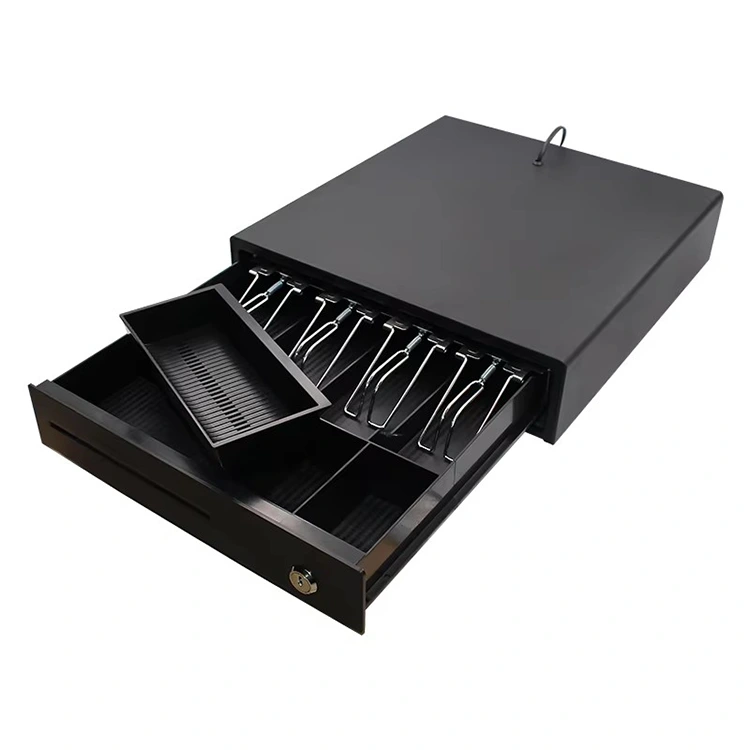
A standard Cash Register Box typically features thin-gauge steel (0.8–1.0 mm), plastic till dividers, and basic spring hinges. In contrast, a heavy-duty unit—such as those engineered by Peite—uses 1.5–2.0 mm cold-rolled steel, welded corner brackets, ball-bearing slide rails, and industrial-grade solenoid locks. The table below highlights the core differences:
| Feature | Standard Grade | Heavy-Duty Grade |
|---|---|---|
| Steel Thickness | 0.8 – 1.0 mm | 1.5 – 2.0 mm |
| Drawer Slide Type | Roller friction | Ball-bearing telescopic |
| Lock Mechanism | Cam lock (brass) | Solenoid + dual deadbolt |
| Coin Tray Material | ABS plastic | Reinforced polycarbonate or metal |
| Rated Cycle Life | 200,000 – 300,000 opens | 1,000,000+ opens |
| Average Price Range | $60 – $120 | $180 – $350 |
The Cost-Benefit Calculus for High-Volume Stores
A busy convenience store or quick-service restaurant may open their Cash Register Box 150–200 times per shift. At that frequency, a standard drawer’s springs weaken within 8–10 months, causing partial ejection or jamming. Each jam translates to 3–5 minutes of checkout delay. With an average transaction value of $15 and 4 customers waiting, that is $60 in lost opportunity per incident—not counting employee frustration.
Heavy-duty models from Peite are tested to withstand over 1 million cycles, effectively lasting 5–7 years under the same stress. The upfront extra $100–$200 evaporates when compared to replacing a standard drawer twice within that period ($120–$240) plus the hidden cost of service calls ($75–$150 per visit). Moreover, reinforced steel resists pry attacks, reducing cash shrinkage. For stores handling more than $5,000 in daily cash, the incremental investment is justified within 90 days purely through theft deterrence.
Operational Efficiency Gains
Beyond durability, a premium Cash Register Box improves ergonomics. Heavy-duty slides glide smoothly even when fully loaded with 5–6 kg of coins, preventing the sudden “drop” sensation that often spills change. Peite units include adjustable tension controls, allowing cashiers to tailor resistance to their preference. This reduces repetitive strain—a factor frequently overlooked in turnover calculations.
Additionally, high-volume stores benefit from the larger bill capacity (typically 8–10 compartments vs. 5–6 in entry-level models). Fewer mid-shift cash pulls mean fewer accounting errors and less manager intervention. In a 12-hour operational window, saving just 15 minutes of administrative reconciliation per day translates to over 90 hours annually—equivalent to nearly two extra workweeks.
When Does It Not Make Sense?
The heavy-duty Cash Register Box is overkill for pop-up stalls, seasonal kiosks, or stores with fewer than 50 daily cash transactions. In those cases, the standard drawer’s lifespan aligns naturally with the business cycle, and the capital is better spent on marketing or inventory. Likewise, if your store is transitioning rapidly toward card-only payments, the mechanical wear diminishes significantly. Peite advises conducting a simple audit: count your average daily cash drawer openings over a week. If the number exceeds 400, the heavy-duty variant is not a luxury—it is a necessity.
Frequently Asked Questions About the Cash Register Box
Q1: How do I know if my current Cash Register Box is approaching failure?
A: Listen for grinding noises during ejection, check for uneven gaps between the drawer face and the housing, and observe whether the till tilts forward when fully extended. Another clear indicator is the “double-crank” issue—where the drawer fails to pop on the first signal and requires a second impulse. At Peite, we recommend a monthly “slide-and-lock” test: load the drawer with approximate daily coin weight, open and close it 50 times consecutively. If the action becomes sticky or the latch hesitates, plan a replacement within 4–6 weeks to avoid a peak-hour breakdown.
Q2: Can I retrofit a heavy-duty lock mechanism into my existing standard Cash Register Box?
A: Technically possible, but rarely cost-effective. The lock cylinder, solenoid, and linkage assembly are designed around specific chassis dimensions. Standard drawers lack the internal mounting brackets and reinforced strike plates needed for a heavy-duty solenoid. Even if you manage to install an aftermarket lock, the thin steel surrounding it becomes the weakest link—a crowbar can still deform the faceplate. Peite engineers construct the entire housing as a unified security system; upgrading only the lock is like putting a vault door on a cardboard shed. For high-volume stores, a complete heavy-duty Cash Register Box replacement is the only reliable path.
Q3: How does the warranty differ between standard and heavy-duty Cash Register Box models?
A: Most standard drawers carry a 1-year limited warranty covering manufacturing defects but explicitly excluding wear on springs, slides, and electronic components. Heavy-duty units from reputable brands like Peite offer 3–5 years of comprehensive coverage, including mechanical fatigue and solenoid failure, provided the drawer is used within specified cycle limits. Additionally, premium warranties often include next-business-day advance replacement—a critical feature for high-volume stores that cannot afford even one day of manual cash handling. Always read the fine print: some “heavy-duty” labels merely extend the steel thickness without upgrading the internal slides, so verify the cycle rating rather than relying solely on the marketing term.
Final Verdict
For any store averaging 400+ daily transactions with cash as a primary tender, a heavy-duty Cash Register Box is unequivocally worth the extra cost. The return manifests not only in hard savings (fewer replacements, lower theft risk) but also in softer metrics (cashier satisfaction, faster checkout lines, and managerial peace of mind). Conversely, lower-volume operations should stick with standard drawers and reserve capital for other priorities. The decision ultimately rests on your transaction data—not on brand hype.
At Peite, we design our heavy-duty Cash Register Box series with input from real store managers, ensuring every gauge, hinge, and lock addresses real-world friction points. We invite you to compare our cycle-test reports against any competitor’s—transparency is part of our build philosophy.
Ready to stress-test a heavy-duty unit in your busiest lane? Contact our commercial team today for a free on-site assessment and volume-based pricing. We will help you match the right Cash Register Box to your daily throughput, and if you are upgrading from a standard model, we will offset your first-year maintenance costs through our trade-in program. Reach out via the form below or call our support line—your next smooth shift starts with Peite.