

How to Control Temperature Gradient in a Large Sized Resistance Heating SiC Crystal Growth Furnace for High-Quality Boules
2026-06-10
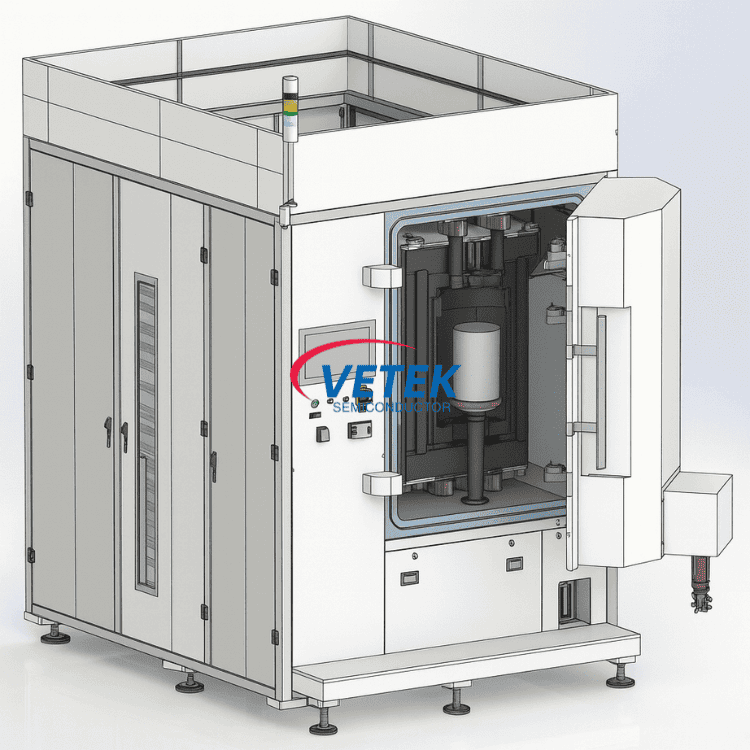
Achieving superior SiC boules begins with precise thermal management. In a Large Sized Resistance Heating SiC Crystal Growth Furnace, the temperature gradient directly dictates crystal quality, defect density, and yield. At Veteksemi, we specialize in optimizing this critical parameter for industrial-scale production.
Why Temperature Gradient Control Matters
A steep axial gradient promotes high growth rates but risks micro-pipes and thermal stress. Conversely, a flat radial gradient improves uniformity but may slow deposition. The ideal balance enables 6-inch and 8-inch boules with low dislocation density.
Key Control Strategies (From Veteksemi)
| Parameter | Optimal Range | Impact on Boule Quality |
|---|---|---|
| Axial Gradient | 15–25 °C/cm | Controls growth rate & polygonization |
| Radial Gradient | < 5 °C/cm | Prevents edge cracks & stress birefringence |
| Hot Zone Insulation | Multi-layer graphite felt | Enhances thermal stability |
-
Heater design: Multi-zone resistive heaters allow independent power tuning.
-
Coil/pedestal positioning: Adjusting the crucible height within the Large Sized Resistance Heating SiC Crystal Growth Furnace modifies the isotherm shape.
-
Real-time pyrometry: Closed-loop feedback reduces drift to ±1.5°C.
Large Sized Resistance Heating SiC Crystal Growth Furnace – FAQ
Q1: What is the ideal temperature gradient for 150mm SiC boules in a Large Sized Resistance Heating SiC Crystal Growth Furnace?
A1: For 150mm boules, Veteksemi recommends an axial gradient of 18–22 °C/cm at the crystal-melt interface and a radial gradient below 4 °C/cm. This range minimizes basal plane dislocations (BPDs) while maintaining a usable growth rate of 0.3–0.5 mm/h. Too steep a gradient (>30 °C/cm) induces thermal shock and micro-cracks near the boule periphery.
Q2: How does the hot zone configuration affect gradient reproducibility across multiple runs?
A2: Reproducibility depends heavily on insulation aging and electrode degradation. In a Large Sized Resistance Heating SiC Crystal Growth Furnace, Veteksemi uses modular graphite felt stacks with replaceable inner shields. After every 10 runs, we recalibrate the axial offset of the heating elements. This maintains gradient consistency within ±2 °C/cm over 50+ growth cycles, directly boosting boule-to-boule uniformity.
Q3: Can numerical simulation predict optimal gradients before physical trials?
A3: Yes. Veteksemi employs coupled CFD-thermal finite element models (FEM) specific to each Large Sized Resistance Heating SiC Crystal Growth Furnace. Input parameters (power, pressure, argon flow) generate a 3D isotherm map. We typically run 20–30 virtual iterations to pinpoint the gradient profile that yields flat interfaces and negligible thermal stress. This reduces experimental trial costs by over 60%.
Conclusion
Mastering the temperature gradient in a Large Sized Resistance Heating SiC Crystal Growth Furnace transforms SiC boule quality. Veteksemi delivers turnkey furnace solutions with embedded multi-zone control, real-time monitoring, and gradient simulation tools.
Contact us today to discuss your SiC crystal growth requirements and request a customized thermal profile analysis.