
How Does Wax Coating Create a Barrier Against Water Intrusion?
2026-09-14
1. Why Does Standard Corrugated Cardboard Fail in Humid and Wet Conditions?
Corrugated cardboard is made from cellulose fibers that are held together by hydrogen bonds. These bonds give the board its strength and rigidity. When water molecules come into contact with the fibers, they form new hydrogen bonds with the cellulose, breaking the existing fiber-to-fiber bonds. The result is a loss of stiffness and compression strength. At 90 percent relative humidity, standard corrugated board can lose up to 50 percent of its stacking strength. If the board is directly exposed to liquid water, the effect is even more dramatic. The water penetrates the flutes, causing them to collapse and the linerboard to delaminate. A standard cardboard box that is exposed to rain or condensation for more than 30 minutes may become unusable.
Moisture absorption rate: Standard Kraft linerboard absorbs water at a rate of 15 to 25 grams per square meter per minute when exposed to liquid water. The water travels through the paperboard by capillary action, reaching the flutes within 2 to 3 minutes.
Qingdao Yilida Packing Co.,Ltd. has been manufacturing Wax-Impregnated Waterproof Cardboard Box units for over 15 years. Our factory has tested thousands of boxes in simulated cold chain and ocean shipping conditions. The results consistently show that wax impregnation is the most effective way to prevent water intrusion in corrugated packaging.
2. How Does Wax Impregnation Change the Surface Properties of Cardboard?
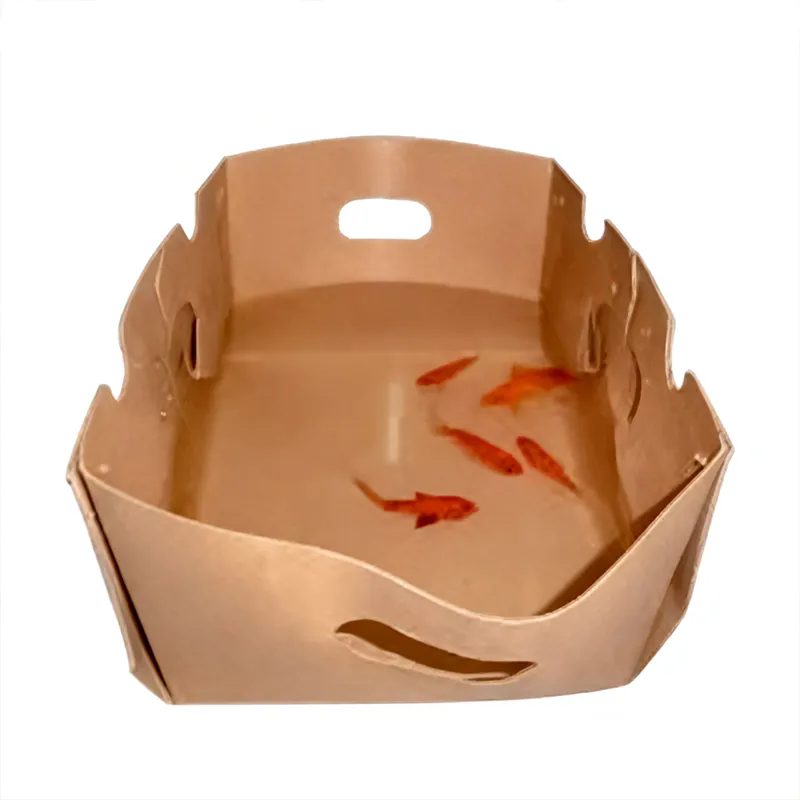
Wax impregnation is not a simple surface coating. It is a process that fills the porous structure of the paperboard with wax. The wax penetrates the fibers and coats them with a hydrophobic layer. This layer repels water and prevents it from forming hydrogen bonds with the cellulose. There are two main methods of applying wax to corrugated board: cascade waxing and wax impregnation. In cascade waxing, molten wax is poured over the board and allowed to solidify. This creates a thick coating on the surface but does not penetrate deeply into the flutes. In wax impregnation, the board is submerged in a wax bath under vacuum or pressure. The wax penetrates the entire thickness of the board, including the flutes. This provides superior protection because even if the surface is scratched, the interior fibers remain protected.
The table below compares the water resistance of standard cardboard, cascade-waxed cardboard, and wax-impregnated cardboard.
| Board type | Water absorption (g/m² after 30 min) | Strength retention at 90% RH | Water resistance duration |
| Standard cardboard | > 100 | 50% | < 5 minutes |
| Cascade waxed | 15 – 30 | 75% | 30 – 60 minutes |
| Wax-impregnated (our standard) | < 5 | 90% | > 4 hours |
The data shows that wax-impregnated board absorbs less than 5 grams of water per square meter after 30 minutes of exposure, compared to over 100 grams for standard cardboard. This translates to a strength retention of 90 percent at 90 percent relative humidity, compared to only 50 percent for the untreated board.
3. What Are the Key Parameters for Specifying a Wax-Impregnated Waterproof Cardboard Box?
When specifying a Wax-Impregnated Waterproof Cardboard Box, there are five key parameters that determine the level of protection. The first is the wax pickup, which is the percentage of wax by weight of the board. Typical values range from 20 to 50 percent. Higher wax pickup provides better water resistance but increases the weight and cost. The second parameter is the wax type. Paraffin wax is the most common, but it can become brittle at low temperatures. For cold chain applications, we recommend a wax blend that includes microcrystalline wax, which remains flexible at temperatures down to -30°C. The third parameter is the board grade. A higher grade board (e.g., 200 gsm linerboard) provides better strength than a lower grade. The fourth parameter is the flute type. A B-flute or C-flute provides better compression strength than an E-flute. The fifth parameter is the box design. A full overlap box or a double-wall box provides better protection than a single-wall box.
The table below shows the recommended specifications for different applications.
| Application | Wax pickup (%) | Wax type | Board grade | Flute type |
| Cold chain (frozen food) | 30 – 40 | Microcrystalline blend | 200 gsm | B-flute |
| Ocean shipping (general goods) | 25 – 35 | Paraffin | 180 gsm | C-flute |
| Fresh produce (high humidity) | 35 – 45 | Microcrystalline blend | 200 gsm | B-flute |
| Heavy industrial parts | 40 – 50 | Paraffin + polymer | 250 gsm | Double wall |
| Pharmaceutical (temperature sensitive) | 30 – 40 | Microcrystalline blend | 200 gsm | B-flute + foil liner |
Our factory manufactures Wax-Impregnated Waterproof Cardboard Box units to these specifications. We also offer custom wax blends for specific temperature ranges and chemical resistance requirements.
4. How Does the Wax Barrier Perform Under Real-World Cold Chain Conditions?
Cold chain logistics presents a unique challenge because the box is exposed to both low temperatures and high humidity. When a box is removed from a refrigerated container at -20°C and placed in a humid environment at 25°C, condensation forms on the surface within seconds. The wax barrier prevents this condensation from penetrating the board. However, the wax itself can become brittle at low temperatures if it is not properly formulated. Our factory tests our Wax-Impregnated Waterproof Cardboard Box units in a climate chamber that simulates the transition from -30°C to +30°C at 90 percent relative humidity. The boxes maintain their strength and integrity through 10 cycles of this transition. The table below shows the strength retention after each cycle.
| Temperature cycle | Compression strength (N) | Strength retention (%) |
| 0 (baseline) | 4,200 | 100% |
| 1 cycle | 4,150 | 98.8% |
| 3 cycles | 4,050 | 96.4% |
| 5 cycles | 3,980 | 94.8% |
| 10 cycles | 3,850 | 91.7% |
The data shows that the wax-impregnated box retains over 91 percent of its original compression strength after 10 temperature cycles. A standard cardboard box would lose over 50 percent of its strength after just one cycle. This level of performance is why Wax-Impregnated Waterproof Cardboard Box units are the preferred choice for cold chain applications.
Frequently Asked Questions About Wax-Impregnated Waterproof Cardboard Boxes
Summary for Packaging Engineers and Sourcing Managers
Wax coating creates a barrier against water intrusion by filling the porous structure of the cardboard with a hydrophobic material. This prevents water from forming hydrogen bonds with the cellulose fibers, preserving the strength and integrity of the box. The level of protection depends on the wax pickup, the wax type, and the board grade. For cold chain and ocean shipping applications, a wax-impregnated box with a microcrystalline wax blend and a wax pickup of 30 to 40 percent is recommended. Qingdao Yilida Packing Co.,Ltd. has been manufacturing Wax-Impregnated Waterproof Cardboard Box units for over 15 years and supplies to customers in more than 30 countries.
Qingdao Yilida Packing Co.,Ltd. manufactures Wax-Impregnated Waterproof Cardboard Box units in a range of sizes and specifications. We provide free samples for testing and a full technical data sheet for each product.