

How Does Pulse Width Selection Influence the Performance of a TDR Cable Fault Locator
2026-04-22
When operating a TDR Cable Fault Locator, few settings impact measurement accuracy as profoundly as pulse width. This parameter determines how much energy is launched into the cable and directly affects the device’s ability to identify faults at different distances. Weshine, a trusted name in cable testing solutions, emphasizes correct pulse width selection to achieve reliable fault diagnosis across various cable types and lengths.
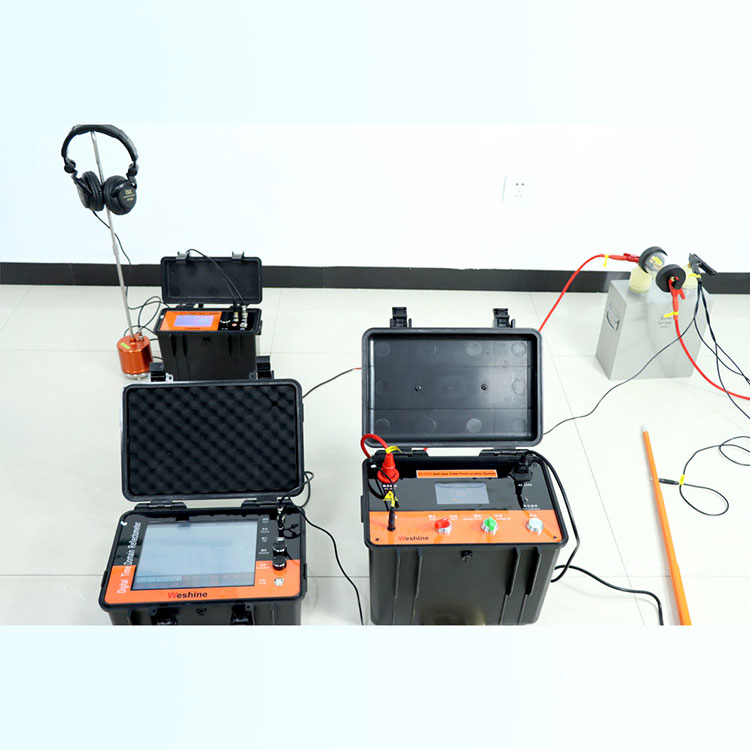
The Core Relationship Between Pulse Width and Performance
A TDR Cable Fault Locator sends a short electrical pulse down a cable. The pulse width—measured in nanoseconds (ns) or microseconds (µs)—controls the pulse duration. Narrow pulses provide high resolution for close-range faults, while wide pulses penetrate longer cables but reduce precision.
| Pulse Width | Typical Cable Length | Resolution | Fault Detection Capability |
|---|---|---|---|
| Narrow (5-20 ns) | < 100 meters | High (cm-level) | Ideal for short, open, and high-resistance faults |
| Medium (50-100 ns) | 100 - 500 meters | Medium (1-3 meters) | Balanced for general-purpose testing |
| Wide (1-10 µs) | > 500 meters | Low (10+ meters) | Suitable for long cables, impedance mismatches |
Key Performance Factors Influenced by Pulse Width
1. Dead Zone Effect
Narrow pulses minimize the dead zone—the minimum distance from the TDR Cable Fault Locator where faults remain invisible. A 10 ns pulse yields a dead zone under 2 meters, critical for diagnosing faults near the connection point.
2. Attenuation and Signal-to-Noise Ratio
Wide pulses combat signal loss in long cables. For a 1 km coaxial cable, a 1 µs pulse returns a detectable reflection, while a 10 ns pulse may attenuate completely before reflecting.
3. Multiple Reflections and Ghost Faults
Excessively wide pulses on short cables create overlapping reflections, producing false positive readings. Seasoned technicians using Weshine devices always start with narrow pulses and incrementally widen them.
Practical Selection Guide
| Cable Type | Length Range | Recommended Pulse Width | Why |
|---|---|---|---|
| Ethernet (CAT6) | 0-90 m | 10-20 ns | High resolution for short, twisted pairs |
| Coaxial (RG59) | 90-300 m | 50-80 ns | Balances resolution and range |
| Power cable (600V) | 300-1000 m | 1-3 µs | Overcomes attenuation in thick conductors |
TDR Cable Fault Locator FAQ
Question 1: What happens if I use a pulse width that is too wide for a short cable?
Using an overly wide pulse on a short cable causes the transmitted pulse to overlap with its own reflection before the reflection returns. This creates a dead zone extending tens of meters, masking any faults within that region. The TDR Cable Fault Locator may display a single, elongated pulse instead of distinct incident and reflected waveforms. For example, a 2 µs pulse on a 50-meter cable makes it impossible to locate a break at 30 meters. Always begin with the narrowest pulse width available on your Weshine device and increase only when no reflection is observed.
Question 2: How does pulse width affect locating high-impedance faults like water-damaged insulation?
High-impedance faults reflect only a tiny fraction of the incident pulse energy. A narrow pulse lacks the total energy to produce a measurable reflection from such a fault. By increasing the pulse width, the TDR Cable Fault Locator sends more total energy into the cable, enhancing the reflected signal amplitude from subtle impedance changes. However, excessive width reduces distance accuracy. For water-damaged underground cables, Weshine recommends a medium width (e.g., 80 ns for 300-meter runs) to balance energy delivery with positional precision.
Question 3: Can pulse width selection help differentiate between a hard short and a loose connection?
Yes, pulse width dramatically changes the reflection signature for different fault types. A hard short (0 ohms) produces a sharp, negative-going reflection regardless of pulse width. A loose or intermittent connection creates a gradual impedance transition. With a narrow pulse (e.g., 15 ns), the TDR Cable Fault Locator resolves this transition as a sloped, elongated reflection. A wide pulse (e.g., 500 ns) smooths out that slope, making the loose connection appear similar to a clean short. Therefore, use narrow pulse widths for fault characterization and wider widths only for distance estimation on long runs.
Best Practices for Pulse Width Optimization
-
Start narrow, then widen: Begin with the shortest pulse and increase until a reflection appears.
-
Document cable type: Weshine devices allow saving pulse width profiles for recurring cable types.
-
Verify with multiple widths: If distance readings vary significantly, your pulse width is likely suboptimal.
-
Consider temperature: Cold cables increase attenuation, sometimes requiring slightly wider pulses.
Contact Us
Mastering pulse width selection transforms a TDR Cable Fault Locator from a basic testing tool into a precision diagnostic instrument. For expert guidance on choosing the right Weshine cable fault locator for your infrastructure or to request a product demonstration, contact us today through the official Weshine website. Our engineering team is ready to help you reduce downtime and pinpoint faults faster.