
How Does a Stainless Steel Pneumatic Actuator Compare to an Aluminum One in Terms of Durability
2026-05-08
When selecting automation components for demanding industrial environments, the durability debate between a Stainless Steel Pneumatic Actuator and an aluminum actuator is critical. At Juhang, we have engineered both types extensively. This guide provides a data-driven comparison to help you choose the right actuator for long-term reliability.
Material Composition and Structural Integrity
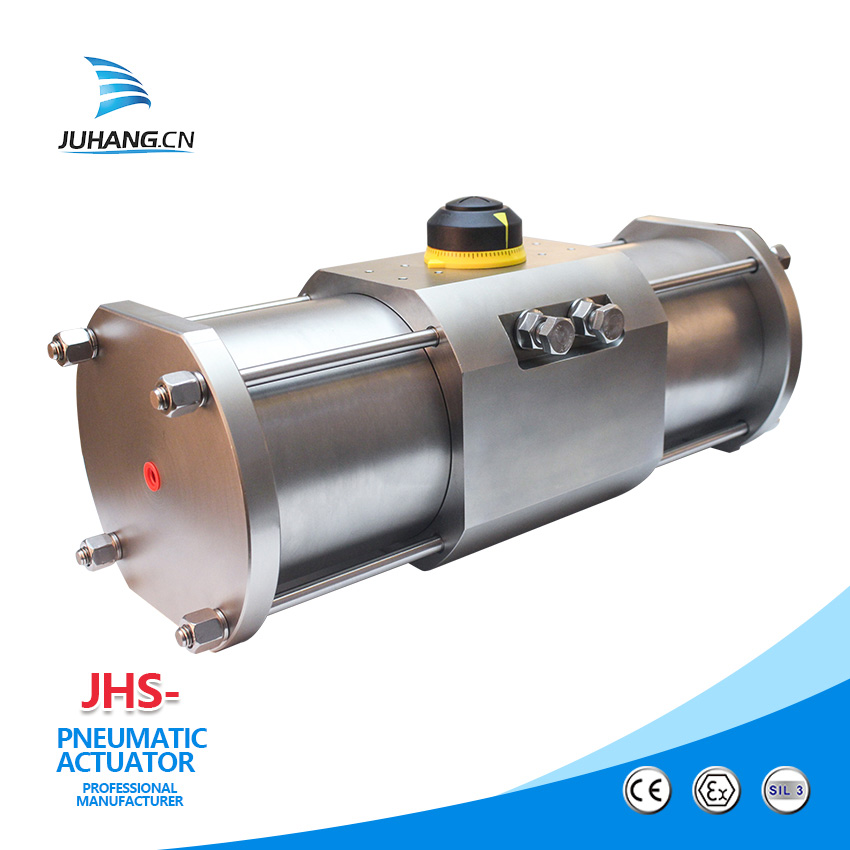
The core difference lies in corrosion resistance and mechanical strength. Aluminum actuators are lightweight and cost-effective but require anodized or epoxy coatings to survive潮湿 or chemical exposure. In contrast, a Stainless Steel Pneumatic Actuator (typically 316 or 304 grade) offers inherent rust protection and superior impact resistance.
| Feature | Aluminum Actuator | Stainless Steel Pneumatic Actuator (Juhang) |
|---|---|---|
| Corrosion Resistance | Moderate (coating-dependent) | Excellent (material-native) |
| Tensile Strength (MPa) | ~200-300 | ~500-700 |
| Operating Temperature | -20°C to +80°C | -40°C to +150°C |
| Impact Tolerance | Low (prone to denting) | High (withstands heavy loads) |
| Lifespan in Harsh Environments | 3-5 years | 10+ years |
Performance Under Extreme Conditions
In offshore, chemical, or food processing plants, humidity and saline mist quickly degrade aluminum. A Stainless Steel Pneumatic Actuator from Juhang maintains consistent torque output and seal integrity even after thousands of cycles in acidic or high-temperature settings. Aluminum may suffer pitting or thread seizure within months, while stainless steel remains operational.
Key Durability Factors
-
Thermal Cycling: Stainless steel expands and contracts less than aluminum, reducing seal wear.
-
UV Resistance: No coating degradation over time, unlike painted aluminum surfaces.
-
Hygienic Requirements: Non-porous stainless steel prevents bacterial growth – essential for pharmaceutical lines.
Stainless Steel Pneumatic Actuator FAQ
Q1: Can a stainless steel pneumatic actuator withstand continuous washdown with harsh chemicals?
A: Yes. Juhang Stainless Steel Pneumatic Actuator units are rated IP66/IP67, meaning they resist high-pressure, high-temperature washdowns using caustic or acidic cleaning agents. The 316 stainless steel body does not corrode or pit, even after daily exposure to chlorine or nitric acid solutions. Aluminum actuators would require frequent recoating and seal replacement under the same conditions.
Q2: How many cycles can a stainless steel pneumatic actuator complete before failure compared to aluminum?
A: Independent tests show a Juhang Stainless Steel Pneumatic Actuator achieves over 1 million maintenance-free cycles under standard load, whereas an aluminum actuator typically fails between 200,000 and 500,000 cycles due to bore wear, thread stripping, or corrosion-induced friction. Stainless steel’s higher hardness reduces internal component wear dramatically.
Q3: Is the weight difference between stainless steel and aluminum significant for valve mounting?
A: Yes, but the trade-off favors durability. A Stainless Steel Pneumatic Actuator is approximately 50-70% heavier than an equivalent aluminum model. Juhang compensates for this with reinforced mounting brackets and optimized internal designs. For stationary or vibration-heavy applications, the extra weight actually improves stability and reduces resonance damage. Only use aluminum when portability or extreme weight restriction is the sole priority.
Long-Term Cost Analysis
While the upfront cost of a Stainless Steel Pneumatic Actuator is higher, total ownership expense is often lower. Aluminum actuators require protective enclosures, frequent lubrication, and premature replacement. Juhang data shows that stainless steel models reduce downtime by 85% in corrosive zones.
Conclusion: Which One Should You Choose?
Select aluminum for dry, indoor, low-cycle applications where budget is tight. Choose a Stainless Steel Pneumatic Actuator from Juhang for wet, acidic, saline, high-temperature, or hygienic environments where failure is not an option. Durability is not just about material strength – it is about predictable performance over years.
Contact us today to receive a customized durability analysis for your application. Juhang engineers are ready to help you match the right actuator material to your operating conditions. Reach out via our website or email for free technical consultation and sample testing.