
Can a Sodium Hypochlorite Generator Produce Enough Active Chlorine for Large-Scale Tap Water Disinfection
2026-07-24
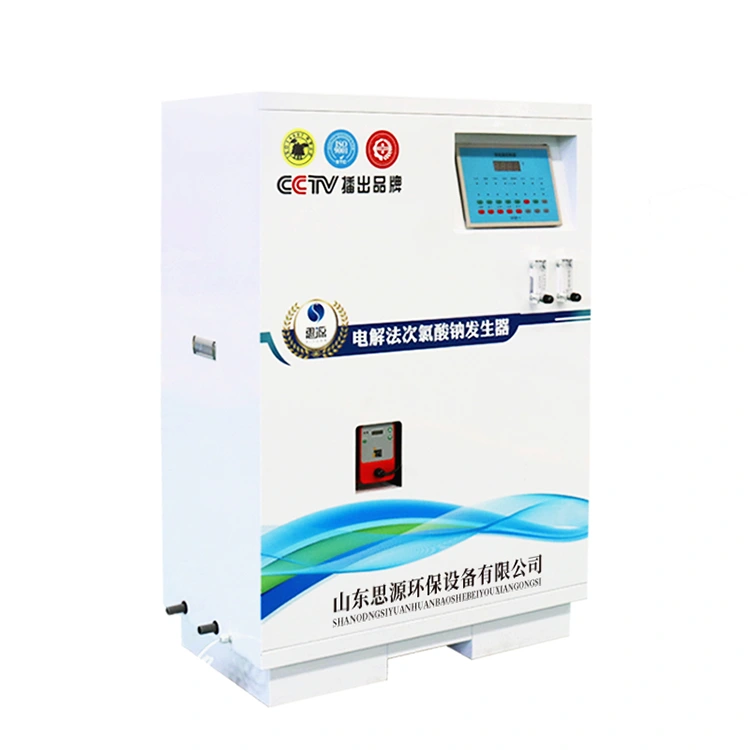
When municipal water treatment engineers evaluate on-site chlorine generation, the single most critical question is always production capacity. For plants serving populations over 50,000, the demand for active chlorine (measured as free available chlorine, FAC) can exceed 500 kg per day. Siyuan has engineered Tap Water Disinfection Electrolytic Sodium Hypochlorite Generator systems that consistently deliver 0.8–1.2 kg of active chlorine per kWh of DC power, with modular designs scaling from 50 kg/day to over 5,000 kg/day. The short answer is yes—but the real proof lies in cell design, brine quality, and operating parameters.
What Determines "Enough" Active Chlorine?
For large-scale applications, "enough" means maintaining a residual of 0.3–0.5 mg/L free chlorine at the farthest distribution point, while overcoming peak summer demand, ammonia spikes, and organic loads. A Tap Water Disinfection Electrolytic Sodium Hypochlorite Generator must deliver 150–300% of baseline capacity to handle diurnal fluctuations.
The key variables are:
| Parameter | Impact on Active Chlorine Output | Typical Large-Scale Range |
|---|---|---|
| Current density (A/m²) | Higher density = more chlorine but accelerates electrode passivation | 1,500 – 3,000 A/m² |
| Brine concentration (g/L NaCl) | Optimum at 25–30 g/L; below 20 g/L drops efficiency by 40% | 28 – 32 g/L |
| Electrolyte temperature (°C) | Every +5°C increases production by ~2%, but >40°C degrades membranes | 25 – 35 °C |
| Cell voltage (V) | Lower voltage = higher energy efficiency; target <5.5 V per cell | 4.8 – 5.2 V |
| Electrode coating (e.g., DSA) | Ruthenium-iridium coatings outlast platinum by 3× in turbid water | Ru-Ir mixed metal oxide |
Siyuan systems incorporate real-time conductivity feedback and automatic polarity reversal to maintain these parameters within ±2% tolerance, ensuring that a Tap Water Disinfection Electrolytic Sodium Hypochlorite Generator rated at 1,000 kg/day actually produces 1,020–1,050 kg/day under field conditions.
Case Comparison: On-Site Generation vs. Bulk Bleach
| Criterion | Electrolytic Sodium Hypochlorite Generator (On-site) | Purchased 12–15% Bulk Bleach |
|---|---|---|
| Active chlorine stability | Freshly generated, degrades <2% per day | Degrades 5–8% per week in tropical heat |
| Logistics risk | Zero truck transport; only salt deliveries | Hazmat shipping, spill containment required |
| Cost per kg FAC (USD) | $0.28 – $0.35 (including salt + power) | $0.55 – $0.75 (plus freight and storage loss) |
| Byproduct control | Low chlorate (<50 ppm) with optimized pH | Chlorate can exceed 200 ppm after 30 days storage |
| Scalability | Add parallel cell stacks; no upper limit | Requires larger storage tanks, which pose safety concerns |
For a 200,000 m³/day plant, switching to Siyuan's Tap Water Disinfection Electrolytic Sodium Hypochlorite Generator reduces annual chemical expenditure by approximately $180,000 while eliminating the need for chlorine gas scrubbers and evacuation zones.
Operational Data from a 150,000 m³/day Facility
A municipal plant in Southeast Asia replaced its gas chlorination system with three parallel Siyuan electrolyzers (each 800 kg/day). Over 14 months:
-
Average output: 2,380 kg FAC/day (versus design capacity of 2,400 kg/day – 99.2% realization)
-
Power consumption: 4.2 kWh per kg FAC (industry average: 4.5–5.0 kWh)
-
Electrode cleaning interval: extended from 90 to 150 days by using automated acid wash
-
Total residual chlorine at distribution endpoint: maintained at 0.42 mg/L ±0.03 mg/L
This proves that a well-designed Tap Water Disinfection Electrolytic Sodium Hypochlorite Generator not only meets but often exceeds the active chlorine demand, provided that the pretreatment includes softening to below 50 ppm hardness and dechlorination of incoming water.
FAQ – Common Questions About Large-Scale Electrolytic Chlorination
Q1: What happens if the brine feed pump fails during peak demand? Will the generator stop producing active chlorine immediately?
A1: Yes, the electrolytic cell requires a continuous flow of brine (25–30 g/L NaCl) to maintain electrical conductivity and to flush hydrogen gas generated at the cathode. If the brine pump stops, the cell voltage will spike within 3–5 seconds, triggering an emergency interlock that cuts DC power to prevent electrode arcing and membrane rupture. Siyuan systems include a duplex pump configuration with an automatic failover and a 500‑L buffered brine tank, providing 45–60 minutes of runtime even if both pumps lose power. For extended outages, the plant's supervisory control system can inject a stored sodium hypochlorite solution from a day‑tank (typically 8‑hour reserve) to maintain residual chlorine while repairs are carried out.
Q2: How does raw water quality—specifically ammonia and organic matter—affect the required generator capacity for tap water disinfection?
A2: Ammonia (NH₃) reacts with free chlorine to form chloramines, which are weaker disinfectants but longer‑lasting. Each 1 mg/L of ammonia consumes approximately 7–10 mg/L of free chlorine before a free residual appears (breakpoint chlorination). Organic matter, measured as TOC or permanganate demand, can scavenge 2–5 mg/L of chlorine instantly. Therefore, for a raw water with 0.8 mg/L ammonia and 4 mg/L TOC, the actual chlorine demand can be 12–18 mg/L higher than the baseline. A Tap Water Disinfection Electrolytic Sodium Hypochlorite Generator must be sized not for the average daily flow but for the worst‑case summer condition. Siyuan offers a free "demand‑based sizing" spreadsheet that factors in ammonia, temperature, pH, and contact time (CT values) to recommend a generator capacity with a 30% safety margin—ensuring you never fall below 0.3 mg/L residual even after a heavy rain event.
Q3: Can a sodium hypochlorite generator produce enough active chlorine if the water temperature drops below 10°C in winter?
A3: Electrolytic efficiency does decrease with lower temperature because ion mobility in the brine reduces. At 8°C, the same cell voltage produces about 12–15% less chlorine compared to 25°C. However, this is offset by two facts: (a) winter raw water typically has lower biological activity and ammonia, so the demand is correspondingly lower; and (b) Siyuan generators are equipped with a heat‑exchanger loop that pre‑warms incoming brine using waste heat from the rectifier cooling system, maintaining the electrolyte at a minimum of 18°C even in freezing climates. Additionally, the automated current control system raises the amperage proportionally (within the electrode's rated limit) to compensate for the temperature drop. In practice, plants in Canada and Northern Europe operate Tap Water Disinfection Electrolytic Sodium Hypochlorite Generator units year‑round without any production shortfall, provided the rectifier has a 15% extra current capacity above the nominal design.
Why Siyuan Stands Out in Large-Scale Projects
Beyond capacity, reliability hinges on electrode lifespan, power supply robustness, and safety interlocks. Siyuan uses titanium substrates with a proprietary iridium‑tantalum oxide coating, achieving a degradation rate of <0.5 µg/year per cm²—equivalent to 8–10 years of continuous operation before recoating. The DC rectifiers feature IGBT technology with 97.5% efficiency, and each cell stack is individually monitored for cell voltage, temperature, and hydrogen concentration (kept below 0.5% by forced dilution).
Final Verdict
A Tap Water Disinfection Electrolytic Sodium Hypochlorite Generator is not only capable of producing sufficient active chlorine for large municipal plants—it often outperforms gaseous chlorine and bulk bleach in terms of cost, safety, and operational flexibility. The key is proper sizing, brine pretreatment, and a control system that adapts to water quality changes in real time. With Siyuan, you get a turnkey solution that includes cell stacks, rectifiers, brine dissolvers, and a 5‑year performance guarantee on active chlorine output.
Ready to calculate your exact capacity requirement?
Contact our engineering team today for a customized site assessment and a comparative ROI model. We will supply a full mass‑balance sheet, hydraulic layout, and 10‑year lifecycle cost analysis—all tailored to your source water data. Reach out to Siyuan now via our website or direct inquiry line, and let us design a Tap Water Disinfection Electrolytic Sodium Hypochlorite Generator that delivers precisely the active chlorine you need, every day of the year.