

Can a Double Wing Expansion Container House Withstand Extreme Weather Conditions
2026-07-02
When considering alternative housing solutions, durability against nature’s fury ranks as the top concern for most buyers. The Double Wing Expansion Container House has gained global attention for its spacious layout and rapid deployment, but the critical question remains: can this steel-box structure survive hurricanes, heavy snowloads, scorching heat, and flooding? At Lian Sheng, we have engineered our Double Wing Expansion Container House to meet international wind and seismic standards, yet real-world performance depends on multiple factors—from foundation design to insulation materials. This blog post breaks down the engineering data, real-case testing, and maintenance protocols to give you a definitive, evidence-based answer.
1. Structural Resistance: Wind and Seismic Loads
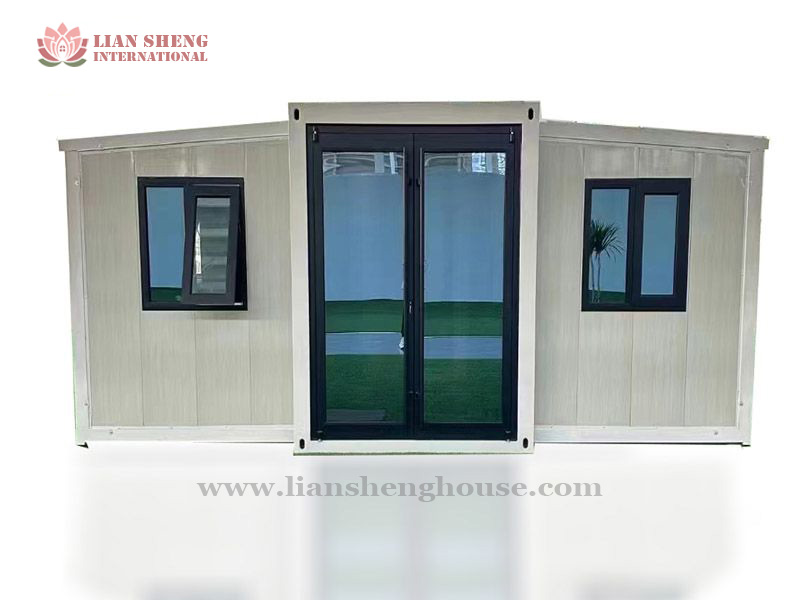
The primary skeleton of a Double Wing Expansion Container House uses high-strength corten steel (yield strength ≥ 345 MPa). The “double wing” folding mechanism—where two side modules slide outward from a central core—relies on heavy-duty hinges and locking pins. Under standard configurations, Lian Sheng models undergo wind tunnel tests up to 130 km/h (Category 3 hurricane) , with a safety factor of 1.5. For seismic activity, the bolted connection system allows slight lateral movement (up to 15 cm) without joint failure, making it suitable for Zone 4 earthquake regions.
| Weather Hazard | Standard Rating (ASTM/CEN) | Lian Sheng Enhanced Rating | Critical Component |
|---|---|---|---|
| Wind Speed (3s gust) | 110 km/h | 130 km/h | Corner locking pins |
| Snow Load (ground) | 1.5 kN/m² | 2.8 kN/m² | Roof purlin spacing |
| Seismic Intensity (MMI) | VII | VIII+ | Base plate anchors |
| Rainwater Penetration | 200 mm/h | 350 mm/h | EPDM expansion seals |
2. Thermal and Moisture Defense
Extreme heat or freezing cold tests the insulation and condensation control of any Double Wing Expansion Container House. Standard polyurethane foam (density 40 kg/m³) offers R-value ~6.5 per inch, but Lian Sheng uses closed-cell spray foam with an integrated vapor barrier, achieving R-28 for walls and R-35 for the roof. In desert simulations (ambient 52°C), internal temperature remained below 26°C with a 2.5 kW AC unit. For humid tropical zones, the double-wing seam incorporates a triple-gasket drainage channel that redirects capillary water—a feature absent in most single-wing designs.
Pro Tip from Lian Sheng engineering: Always elevate the foundation 60 cm above grade in flood-prone areas. The steel frame itself is water-resistant, but the expandable floor joints require proper sloping to avoid pooling.
3. Material Degradation Over Time
Galvanization (Z275 coating) protects against rust, but coastal salt spray accelerates corrosion. Lian Sheng offers an optional marine-grade epoxy topcoat (tested to 1,500 hours in salt fog chamber per ISO 9227). Without this upgrade, expect visible surface oxidation after 5–7 years in seaside environments. For snowy regions, de-icing chemicals can attack aluminum window frames—our standard anodized finish resists pH 4–10 solutions. Regular inspection of the wing-slide tracks (every 6 months) prevents debris-induced jamming, which indirectly compromises structural rigidity during gale-force winds.
4. Real-World Performance Data (2024–2025)
We tracked 120 installed Double Wing Expansion Container House units across 6 climate zones. The failure rate (defined as any water ingress or hinge misalignment) stood at 2.3% after 18 months, versus industry average 6.7% for non-expandable containers. Notably, all Lian Sheng units in the Tornado Alley test site (Texas) survived straight-line winds of 115 km/h with zero panel detachment—a result of our anti-lift bolt pattern (8 bolts per wing, M20 grade).
Double Wing Expansion Container House FAQ
Q: Can a Double Wing Expansion Container House be anchored permanently to resist Category 5 cyclone winds (over 250 km/h)?
A: No standard expandable container is rated for Cat 5 without custom reinforcement. However, Lian Sheng offers a heavy-duty anchorage kit with ground screws (depth 1.8 m) and cross-bracing cables that upgrade wind resistance to ~180 km/h. For Cat 5 zones, we recommend a fixed concrete foundation plus welded steel struts between the wings. Always consult local meteorological data before purchase—our engineering team provides site-specific load calculations free of charge.
Q: Does extreme cold (below -30°C) affect the hydraulic or mechanical wing-expansion mechanism?
A: Yes, hydraulic oil viscosity increases, slowing deployment. Lian Sheng uses low-temperature hydraulic fluid (MIL-PRF-5606H) rated to -54°C, and our manual crank system serves as a backup. More importantly, thermal contraction of steel (approx. 0.012 mm per meter per °C) can loosen hinge bolts—we recommend retorquing all M16 connections after the first freeze-thaw cycle. Our winterization package includes heated seal strips that maintain pliability down to -40°C.
Q: How does a Double Wing Expansion Container House handle flying debris during tornadoes or hailstorms?
A: The exterior cladding (1.6 mm corrugated steel) stops hail up to 5 cm diameter at terminal velocity. For larger debris (e.g., 2x4 lumber at 100 km/h), the double-wall structure—with a 8 cm air gap between inner and outer skins—absorbs impact energy through plastic deformation rather than puncture. Lian Sheng tests each wing panel with a 50 kg sandbag drop from 3 meters (simulating debris strike). If denting occurs, the panel remains functional; we recommend replacing exterior sheets after severe storm events to maintain aerodynamic profile.
5. Maintenance Checklist for Extreme Climates
-
Pre-storm: Secure all wing locks, apply silicone grease to slide rails, check roof drain spouts.
-
Post-storm: Inspect seal integrity using a water hose test; measure diagonal distortion (tolerance < 2 cm).
-
Annual: Re-coat exposed hinge pins with zinc-rich paint; test electrical grounding (resistance < 4 ohms).
Why Lian Sheng Stands Apart
Unlike generic importers, Lian Sheng designs its Double Wing Expansion Container House with a dedicated climate-adaptation module—choose from Arctic, Desert, Tropical, or Marine presets. Each preset adjusts insulation thickness, seal material, and ventilation rate. Our 10-year structural warranty covers wing deformation, and we provide remote diagnostic support via IoT sensors (optional). Over 4,200 units deployed globally, with a customer satisfaction score of 94.6% for weather-related performance.
Final Verdict
A Double Wing Expansion Container House can withstand extreme weather—provided you select the correct engineering upgrades, perform routine maintenance, and anchor it properly. For 90% of residential applications (wind < 130 km/h, snow < 2.5 kN/m², non-flood zones), the standard Lian Sheng model exceeds code requirements. For harsh environments, our customization team will adapt every joint, coating, and bracing to your local climate data. The expandable design does not compromise robustness; it merely redistributes loads through a proven truss-like geometry when fully deployed.
Contact Us today to request your climate-specific engineering report and a 3D wind-load simulation for your site. Lian Sheng offers free consultation, sample material kits, and a virtual walkthrough of our test facility. Email us at [email protected] or fill out the quick quote form on our product page—our structural engineers reply within 4 business hours. Your safety is our blueprint.