

3D TPU Heat Transfer Label Factory: Custom Durable Designs for Apparel Branding
2026-10-19
If your apparel brand still relies on woven tags or flat rubber prints, you’ve probably already felt the limits: edges peel, details blur, and the premium look fades after a few washes. A 3D TPU heat transfer label factory changes that by molding depth, texture, and durability directly into the label—no stitching, no fraying, no shortcuts. That’s exactly the gap Victorygen heat transfer label was built to fill: dimensional branding that survives real wear and tear while keeping production simple. In this post, we’ll break down the production process, material options, and the design details that separate forgettable tags from labels people actually notice.
Why Thick TPU Beats Flat Prints on Stretch Fabrics
When a stretch fabric flexes, a flat print has nowhere to go. It gets pulled apart, shows cracks, and loses its shape after just a few wear cycles. Thick TPU, on the other hand, holds its own. The extra depth lets it move with the fabric instead of against it, so the design stays intact even when the material stretches to its limit.
The difference comes down to how the material handles stress. Flat prints sit on the surface, bonded only at the thinnest layer. Once the fabric starts pulling, that bond breaks. Thick TPU forms a solid, flexible film that distributes the force across the whole design. You end up with a graphic that keeps its edges clean and its colors vivid, no matter how much yoga, running, or everyday bending you put it through.
There's also a tactile upgrade you can't ignore. Flat prints feel like an afterthought - smooth but cheap. Thick TPU gives a raised, rubbery texture that feels premium and durable. It doesn't peel at the corners after a few washes, and it doesn't fade into a dull smear. For stretch-performance clothing that has to look good after dozens of workouts, thick TPU is simply the smarter way to print.
From Sketch to Mold: Inside the Custom Label Process
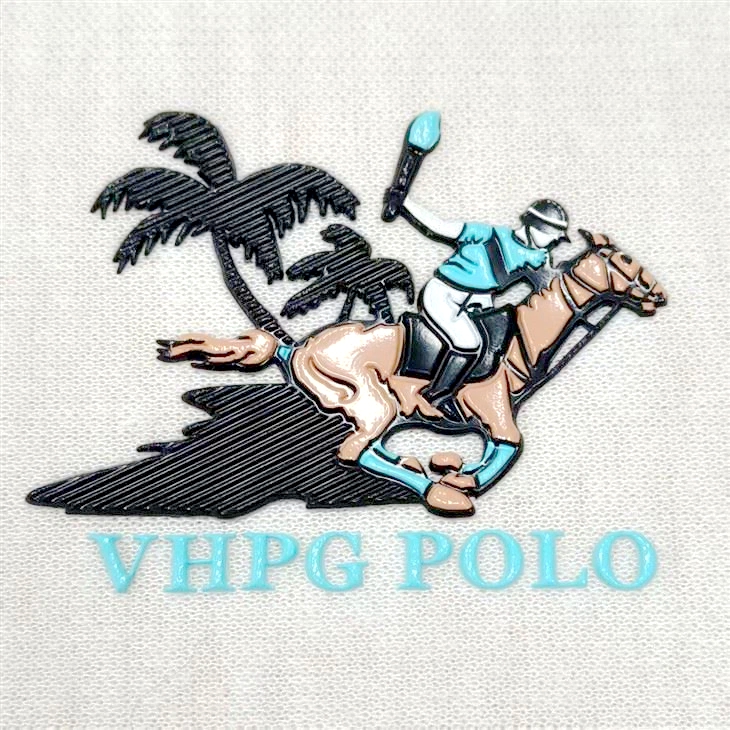
Most custom labels begin as a rough pencil sketch or a note on a napkin. That loose idea gets tightened into a vector file, where every curve, letter width, and border thickness is argued over. It’s the last cheap place to make changes—once metal is involved, a tweak means starting a new blank.
After sign-off, the design is handed to the mold maker. A block of brass or steel is mounted and cut in reverse, slowly carving out the raised letters and recessed backgrounds. Fine serifs and hairline borders are the usual troublemakers. The cutter may need several passes, and the mold maker keeps checking depth and sharpness under a loupe before calling it done.
The first test stamp on actual material tells you more than any screen preview. If the impression is too shallow or a corner doesn’t fill, the mold goes back for a touch-up. Sometimes it’s a ten-minute fix; sometimes the whole cavity is recut. Only when the sample matches the original sketch—minus the smudges—does the mold get cleared for a production run.
Material Blends That Keep Edges from Cracking
Edge cracking often starts microscopically long before it becomes visible, so the choice of material blend matters far more than surface treatments or post-processing. Blends that combine a rigid polymer backbone with a small percentage of elastomeric modifier—typically in the 5–15% range—can absorb stress concentrations at parting lines and sharp corners. The elastomer domains act as tiny shock absorbers, distributing load away from the vulnerable edge zone and allowing the part to flex just enough to prevent crack initiation.
Another effective route is pairing brittle engineering resins with short glass fiber and a toughening agent, but the ratio needs careful tuning. Too much fiber raises stiffness while making edges more notch-sensitive; too little fiber sacrifices dimensional stability. A balanced blend—often around 20–30% fiber with 5–10% impact modifier—creates a network where cracks are blunted before they can propagate. The result is an edge that survives repeated thermal cycling, vibration, and occasional impact without developing hairline fractures.
For applications exposed to moisture or chemicals, using a blend of semi-crystalline and amorphous polymers can also help. The semi-crystalline phase provides resistance to environmental stress cracking, while the amorphous phase keeps the edge from becoming overly brittle at low temperatures. This combination works especially well in molded housings and snap-fit enclosures, where edge integrity directly affects assembly reliability and long-term appearance.
Small Batch Orders and Other Factory Policies Worth Knowing
Many factories still quote a minimum order quantity that assumes you are a major retailer, but a growing number are quietly open to smaller runs if you ask. The trick is to approach the conversation before you have finalized every design detail. When a factory sees that a small batch can move through the same cutting table and finishing line without disrupting larger jobs, they often agree to a modest increase in per-unit cost rather than turning you away.
Beyond order size, pay attention to how a factory handles sampling, revisions, and lead-time commitments. Some will charge for each pre-production sample, while others fold one or two revisions into the initial quote. Ask what happens if your fabric arrives late or if a component is out of stock. The answer tells you more about their planning culture than any brochure.
Payment terms and quality control can matter just as much as the quantity. A factory that insists on full payment upfront may be protecting itself from cash-flow problems, but that risk shifts to you. A better signal is a clear defect policy and a named point of contact for production updates. These small operational details often separate a reliable partner from a one-off transaction.
How Apparel Brands Use Raised Labels for Visual Identity
Raised labels give apparel a tactile signature that flat prints can't match. Think of the small rubberized logo on a hoodie hem or the embroidered crest on a jacket sleeve—these elements invite touch and create a sensory memory tied to the brand.
Beyond the touch, raised labels act as a quiet status signal. Instead of loud graphics, a textured wordmark on a chest or cuff lets the wearer recognize quality and affiliation, while keeping the overall look understated. This works especially well for minimalist or heritage-inspired lines.
The physical depth also changes how the label catches light and shadow, adding subtle dimensionality that shifts with movement. Brands often use this to reinforce a premium feel, as the slight elevation suggests craftsmanship and attention to detail that screen printing or woven tags often lack.
Testing Wash Cycles Before Your Labels Ship
Before any label leaves our facility, it goes through real wash cycles that mirror what your customers will actually do at home. We don't rely on theoretical abrasion charts or lab-only simulations. Instead, we load sample garments and textile goods into standard household machines, run them through hot, cold, and eco cycles, and then examine every edge, stitch, and printed surface for the kind of fading, cracking, or peeling that only shows up after repeated exposure to detergent and friction.
This hands-on testing often uncovers issues that never appear on a spec sheet. For instance, a woven label might survive a gentle wash but start fraying at the corners after a heavy-duty cycle with towels. Or an ink that looks bold on day one could turn patchy after five washes in hard water. By catching these weaknesses early, we adjust thread tension, switch to a different coating, or reinforce the label backing before a single production run is authorized. The result is a label that doesn't just pass a one-time inspection—it holds its look and legibility for the entire life of the garment.
Ultimately, testing wash cycles before shipping isn't about ticking a compliance box. It's about protecting your brand's reputation every time someone pulls a shirt out of the dryer. When the label still reads clearly and feels smooth after dozens of washes, your customer doesn't think about the label at all—and that's exactly the point.
FAQ
The raised, dimensional surface is the main difference. TPU gives it a flexible rubber feel that moves with fabric, while standard transfers tend to sit flat and can crack over time.
They handle repeated washing, drying, and stretching without lifting or peeling. As long as heat press settings are correct during application, the bond stays strong for the life of the garment.
Yes. We work from your vector artwork to build custom molds and match pantone colors. Even small text and intricate details can be captured if the file resolution is adequate.
Most common apparel fabrics bond well—cotton, polyester, nylon, and cotton-poly blends. Stretch fabrics are fine because TPU flexes with the material rather than fighting it.
It varies based on size and design complexity. The factory can often support smaller initial runs for sampling and then scale up to bulk production once you approve the sample.
A standard heat press is usually sufficient. You just need to follow the recommended temperature, pressure, and time for the specific TPU film being used—no sewing or adhesives needed.
If the label is placed in a high-friction area, some wearers might feel it. Most brands avoid direct skin contact by positioning labels on the outside of necklines, sleeves, or lower hems.
They offer a more modern, tactile look and usually last longer than printed transfers. Many apparel brands switch to 3D TPU for premium lines or activewear where flat tags feel outdated.
Conclusion
When a stretchy performance tee or yoga legging gets branded with a flat print, the result rarely survives a season of movement. That’s why many apparel brands now turn to thick 3D TPU heat transfer labels instead. The raised profile flexes with the fabric rather than fighting it, so the logo stays intact through repeated stretching. A good factory doesn’t just pour any TPU into a mold, though. The material blend matters just as much as the shape. Blends formulated with a softer durometer and a hint of elasticity keep the edges from cracking or lifting after dozens of wear-and-wash cycles. And since not every label run needs to be massive, small batch orders are often welcome—just ask about minimums, setup fees, and lead times before you commit.
The path from your sketch to a finished raised label starts with a digital mockup, moves to a precision-cut mold, and ends with heat application tests on your actual fabric. Factories that care about durability will run wash cycle testing before shipping, checking for peeling, discoloration, or edge fatigue. For apparel brands, these labels go beyond simple branding. A raised TPU mark on a cuff, collar, or chest panel adds a tactile layer of visual identity that flat ink can’t match. It gives the garment a subtle dimensionality, almost like a sculpted signature. When you find a factory that understands material selection, small order flexibility, and rigorous testing, the result is a label that looks as good after fifty washes as it did on day one.
Contact Us
Contact Person: Wang Song Lin
Email: [email protected]
Tel/WhatsApp: +8613751282193
Website: https://www.heat-transferprinting.com/